
Nature photography—whether it’s waiting for a bird to take flight or watching the antics of a young raccoon—can be a powerful way to reduce stress. These quiet, focused moments in wild places offer more than just good pictures. They help settle the mind. And as Elaine, who brings a scholar’s lens to our work, often reminds me: there’s science to back that up.
Wildlife photography: stillness helps the body slow down
A while back, I stood at the edge of a wetland as the sun came up. A duck swam slowly across calm water, and I waited—breathing with the morning, camera in hand. There’s something about those moments. No phone, no traffic, just bird and breath. I always feel better after.

Elaine showed me an article from Psychology Today that said even brief time spent in nature can lower cortisol and blood pressure. Turns out, focusing on wild things—really focusing—has measurable effects. When I’m out with the camera, I feel it in my shoulders, in how I walk back to the truck: lighter, slower, steadier.
Macro photography: small details, big calm
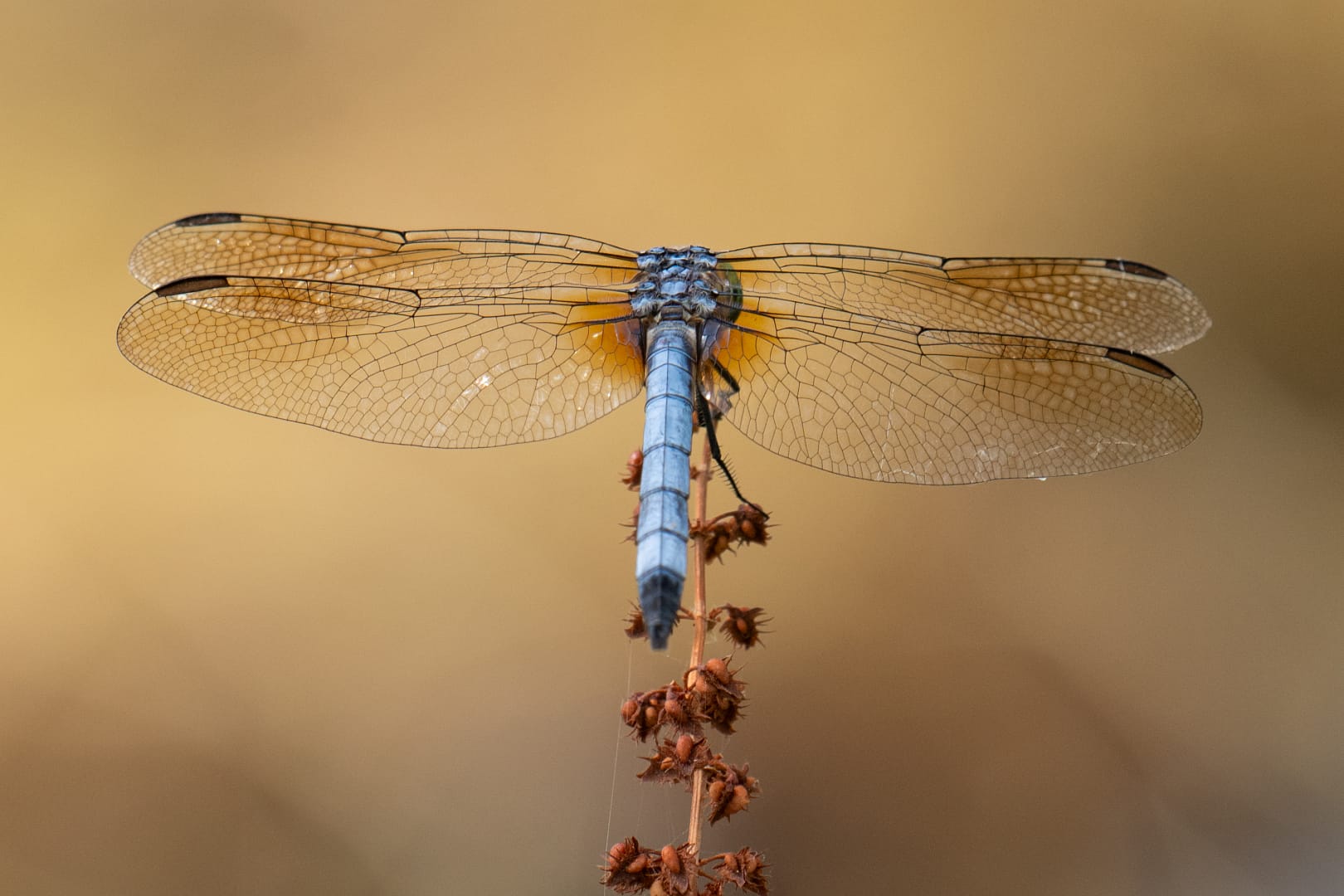
I’ve always liked macro work. There’s peace in leaning close, lining up a shot of lichen on a branch or watching ants crawl a ridge of bark. Elaine pointed me toward research on “fractals”—the repeating patterns found in nature, like the curve of a fern or the web of veins in a leaf. Studies show those patterns can calm the nervous system. They pull the eye gently, which gives the mind a break.

Our visual systems are wired to effortlessly process repetitive natural patterns (called fractal fluency), and seeing patterns helps us feel calm and focused. I never knew the science behind it. I just knew that when I photograph a spider’s web or a flower’s center, I lose track of time—and the knots in my thinking start to loosen.
Landscape photography: wide shots and wide breathing

There’s a kind of reset that happens when I hike into a new spot with a wide-angle lens. Big sky, shifting light, grasses blowing in the breeze. I don’t always find the perfect shot. But I find space.
Elaine has been excited about a line of research showing that even a few minutes in natural light and open space can improve mood and reduce stress. For example, a Harvard Health article explains as few as 20 minutes spent in nature significantly reduced cortisol and blood pressure. Apparently, we’re wired to respond to green places, especially when we move slowly through them.
The camera just gives me an excuse to do that.
Digital detox: why holding a camera matters
When I’m out shooting, my phone is most always in my backpack on silent. My hands are busy with an array of camera functions that control aperture, shutter speed, ISO, and a few other settings that I move through from shot to shot. The weight of the camera and lens pulls me into the moment. There is a shift from the familiar swipe and tap of a smart phone to a much more tactile set of coordinated movements. I am for a while unplugged from the daily Connection Cadence and pleasantly attuned to my natural senses.

Elaine pointed out that this is part of something called Attention Restoration Theory, which suggests our brains recover from mental fatigue when we focus on soft, undemanding stimuli in nature. The act of photographing—of slowing down and focusing without digital overload—lets that recovery happen.
How to use photography to de-stress
- Pick a nearby patch of nature
It doesn’t have to be a National Park. A neighborhood trail or city garden will do. - Walk slow and observe
Let yourself stop often. Look for texture, light, and movement. - Use whatever camera you have
Your phone works fine. What matters is not the gear—it’s the way you look. - Try different subjects
Animals, insects, leaves, bark. Find what holds your eye and let it keep you there a while. - Let the process—not the result—be the reward
Some days I come home with a great image. Some days I just come home feeling better. Both are wins.
The science behind nature photography and stress
Elaine helped me gather the research on this. Turns out, scientists agree that nature photography does more than soothe the soul—it helps the body and brain, too.
- Viewing nature scenes—even digitally—lowers stress hormones
- Repetitive natural patterns (like fractals) ease mental fatigue
- Being in green spaces improves mood and reduces anxiety
- Mindful, immersive activities restore cognitive focus
If you’re looking to learn more, she’s got a growing list of articles and papers that connect the dots between seeing, slowing down, and feeling better.
Final frame
After a long and satisfying photography career, culminating in wildlife conservation, I now work independently as a nature photographer. Excellent photographs continue to be my goal but I’ve discovered additional benefits. My time in the field has a restorative and uplifting effect.
Elaine brings the research. I bring the field time. Together, we’ve come to believe that this kind of seeing is good medicine—for the body, for the mind, and for the spirit.
We would love to hear your thoughts. Visit our comment section and tell us what you think.
Sign up for the best photography tips!
Join our mailing list for featured posts
I was breathing easier and relaxing just reading through and viewing the photos. Thank you for putting light on just being present.
I’m happy to know that you enjoyed this post. I get such a peaceful feeling when I am enjoying nature. I want to inspire our readers to connect with nature in this wonderful way.